
For Tacoma vehicle owners comparing paint-protection services, icon rocklear is a branded coating and finish-preservation approach intended to improve the appearance of painted panels while adding a protective surface layer. It is not the same thing as a conventional ceramic coating, and it is not a transparent plastic film like paint protection film. The practical question is not whether one product is universally “best”; it is whether the system matches your vehicle’s paint condition, driving exposure, maintenance habits, and expectations.
What Icon Rocklear Is—and What It Is Not
Icon Rocklear belongs in the broad category of professionally applied automotive surface-protection systems. The installer prepares the paint, applies the product according to the system’s process, and finishes the surface so the vehicle can present a deeper, cleaner appearance. The outcome depends heavily on preparation: contamination, oxidation, swirl marks, sanding traces, and failed touch-up work cannot be wished away by applying a coating over them.
The useful distinction is between surface protection and impact protection. A liquid-applied coating becomes part of the surface system after application and curing. Paint protection film remains a separate physical layer designed to take abrasion and stone impact before the painted panel does. A coating may make washing easier and help preserve gloss, while film is the more direct answer for repeated road debris on a hood, bumper, mirror, or rocker panel.
If you are comparing systems by their job rather than by marketing language, a general coating helps you compare Icon Rocklear with ceramic coating for vehicle paint protection and sort out which option fits your paint, driving exposure, and maintenance plan.
The three layers of the decision
Think of the choice in three layers:
- Correction: what must happen to the existing paint before protection is applied?
- Protection: which hazards matter most—UV exposure, road film, bird residue, washing abrasion, or stone impact?
- Maintenance: what washing routine will preserve the finish without introducing new defects?
That framework prevents a common mistake: selecting a product first and asking the installer to solve every paint problem afterward. A coating can improve the behavior of a clean surface, but it is not a substitute for a complete paint correction, panel repair, or repaint. Likewise, film can shield a good panel from new damage, but it does not restore clear coat that is already peeling.
How it differs from ceramic coating and PPF
A ceramic coating is generally chosen for a bonded protective layer, gloss, and easier maintenance. The word “ceramic” alone does not identify a uniform level of durability or chemical composition, so the installer should explain the actual preparation, number of layers, curing requirements, warranty terms, and maintenance instructions. Icon Rocklear should be evaluated with the same discipline rather than treated as a magic category.
PPF is a preformed or patterned film installed over painted surfaces. It adds thickness and a sacrificial barrier, but it also introduces seams, edges, installation tolerances, and the possibility of lifting or contamination if the work is poor. For owners focused on keeping the front end free from chips, film placement is often more important than whole-vehicle coverage. A coating can then be considered for uncovered painted surfaces if the maintenance goal justifies it.
Why the Product Choice Matters in Tacoma
Tacoma vehicles experience a mixture of conditions: wet weather, road spray, winter grime, tree residue, bird contamination, construction dust, and highway debris. The right protection strategy depends on where the vehicle is driven and stored. A garage-kept weekend coupe has a different risk profile from a daily commuter crossing the Narrows, a work truck parked outside, or a new SUV used for mountain trips.
Moisture itself is not a reason to promise permanent protection. Water can carry grit onto the paint, leave mineral deposits as it evaporates, and keep contamination in contact with a dirty panel. The coating’s value is partly practical: if the surface releases dirt more readily and the owner washes it correctly, there may be fewer opportunities for contamination to be rubbed across the finish.
Protection reduces exposure; it does not eliminate maintenance. That distinction matters for owners who expect a protected vehicle to remain flawless without washing. A bird dropping, insect residue, or tree sap should still be removed promptly when practical. The longer a contaminant sits in sun and moisture, the greater the chance that cleaning will require more than a gentle wash.
Match the hazard to the barrier
- Gloss and easier washing: evaluate a coating system after paint preparation.
- Front-end stone chips: prioritize PPF on impact zones.
- Swirl marks and oxidation: correct the paint before choosing the protection layer.
- Privacy, glare, and solar load: evaluate window film separately from paint protection.
- Resale presentation: correct obvious defects and choose protection that the next owner can maintain.
Window tint is a separate decision because it protects glass and changes the cabin experience, not the painted exterior. Washington’s tint requirements are established in state law, so a Tacoma owner should confirm the applicable vehicle and window rules before selecting a film or darkness level. The current statute is available through the Washington Legislature’s RCW 46.37.430 page, which is the appropriate place to verify legal requirements in 2026 rather than relying on an installer’s old chart or an online forum.
Solar performance also should not be confused with darkness. The U.S. Department of Energy explains that window treatments and films can affect solar heat gain and glare, but the result depends on the product and the window application; the energy guidance is not a promise that every automotive film performs identically. Review the manufacturer’s specifications and legal fit for the vehicle before treating tint as a universal heat solution. See the U.S. Department of Energy guidance on window treatments for the underlying solar-control principles.
An illustrative exposure worksheet
The following is a planning example, not a universal threshold or performance guarantee. Assign each exposure a simple score from 1 to 3, then use the result to guide a conversation with the installer:
- A commuter drives 60 miles per day on a mixture of urban roads and freeway routes: impact exposure, 3.
- The vehicle is parked outdoors for 10 hours on most workdays: contamination and weather exposure, 3.
- The owner washes it every two weeks but uses a touchless wash: maintenance consistency, 2.
- The owner keeps the vehicle in a garage and drives it 1,500 miles per year: impact exposure, 1.
- A used vehicle has visible oxidation and moderate wash marks: correction need, 3, regardless of which protection product is selected.
The numbers above are merely an illustrative decision tool. They do not predict coating life, film life, gloss retention, or paint condition. Their purpose is to expose mismatches: a high-mileage commuter may need impact film in strategic zones, while a garage-kept enthusiast may place more value on correction and finish maintenance.
How a Professional Application Works
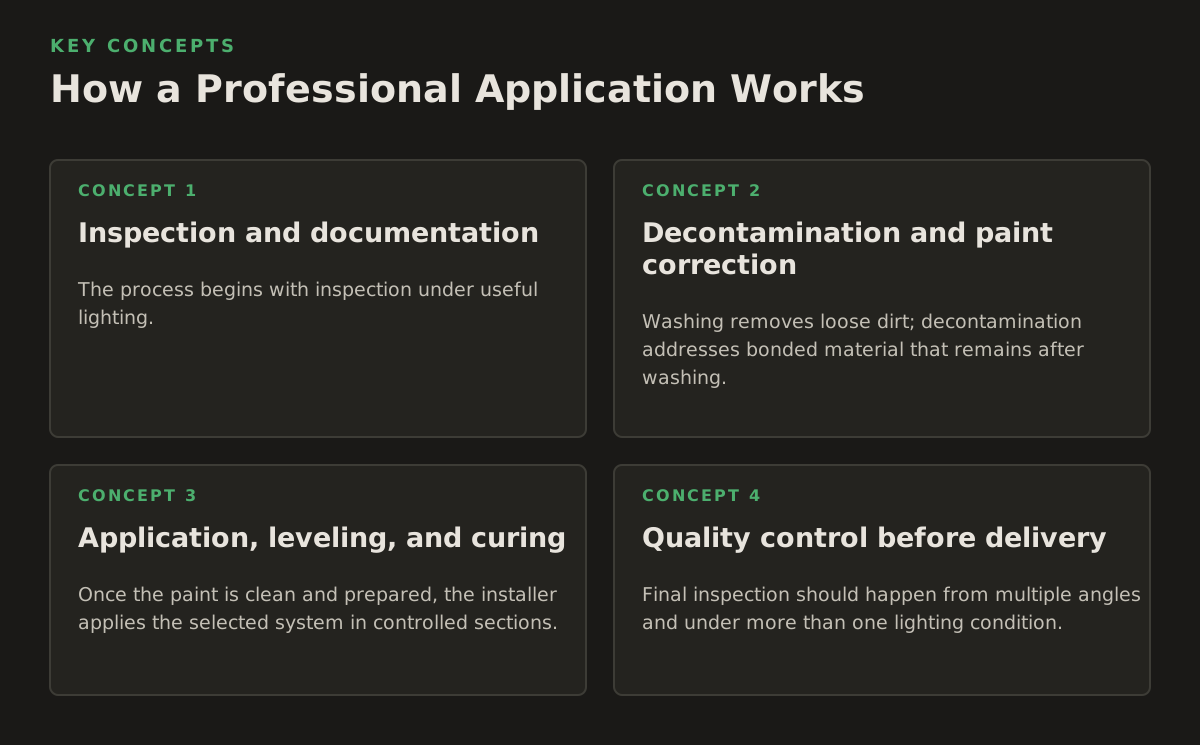
The application is best understood as a sequence of controlled decisions, not a single wipe-on step. Preparation determines the ceiling of the result. If the surface is oily, contaminated, chemically stained, or visibly marred, the product may lock in an uneven appearance or make later correction more complicated.
Inspection and documentation
The process begins with inspection under useful lighting. The technician should identify repainted panels, edge damage, clear-coat failure, deep scratches, dents, rock chips, trim staining, and areas where previous products have failed. A realistic estimate of correction is impossible if the vehicle is judged only under a parking-lot light.
Owners should ask whether defects will be corrected, improved, or simply preserved under the protection layer. “Improved” is an important word: a deep scratch that reaches the basecoat may not be safely removed by polishing because removing enough surrounding clear coat could create a thinner or weaker area. A responsible recommendation may be to soften its appearance, leave it, repair the panel, or use PPF to limit future exposure.
Decontamination and paint correction
Washing removes loose dirt; decontamination addresses bonded material that remains after washing. Depending on the vehicle, that may include iron particles, tar, road film, and mineral residue. The exact chemistry and tools should be selected for the paint and contamination rather than applied as a fixed ritual.
Paint correction then uses polishing, and sometimes measured sanding, to reduce defects. Correction is a trade-off between appearance and remaining clear coat. Maximum defect removal is not always the safest objective. On a daily driver with thin or previously corrected paint, a controlled improvement may be wiser than chasing every isolated mark.
A typical preparation conversation should cover:
- Which panels will receive correction?
- Which defects are too deep or risky to remove?
- Will emblems, trim, and sensitive edges be protected during polishing?
- How will residue be removed before the coating is installed?
- What happens if a panel has evidence of a previous repaint?
Application, leveling, and curing
Once the paint is clean and prepared, the installer applies the selected system in controlled sections. The product must be spread evenly, allowed to set for the appropriate working time, and leveled without leaving high spots, streaks, or missed areas. Temperature, humidity, dust, lighting, and the condition of the applicators all matter because they affect how the material behaves before it stabilizes.
Do not treat a vehicle as fully ready for immediate hard use simply because the final wipe is complete. The installer should provide written instructions for the initial curing period, washing, rain exposure, bird residue, and accidental contamination. If the vehicle must be delivered during uncertain weather, the shop should explain how it will be kept clean and dry during the early stage.
For Icon Rocklear specifically, ask which exact system and process are being proposed, what preparation is included, and what the maintenance requirements are. Product names can cover different packages or installer procedures. The written scope is more useful than a label alone because it turns vague expectations into checkable steps.
Quality control before delivery
Final inspection should happen from multiple angles and under more than one lighting condition. High spots may look acceptable in diffuse indoor light and become obvious under a point source. Edges, panel gaps, mirrors, handles, and transition areas deserve special attention.
Before accepting the vehicle, the owner should confirm:
- The paint correction level and remaining visible defects.
- The areas covered by the product and any excluded trim or repaired panels.
- The date and method of the first permitted wash.
- The approved chemicals, towels, and drying method.
- The process for documenting a warranty or appearance concern.
Where Icon Rocklear Can Break Down
Every protection system has failure modes. Some are product-related, but many are caused by poor substrate preparation, incorrect use, unrealistic expectations, or maintenance that defeats the surface. A useful explainer should make those limits clear before the vehicle enters the bay.
It cannot repair structural paint damage
Peeling clear coat, rust bubbling beneath the paint, severe oxidation, cracked plastic, and deep chips require a repair decision. Applying a new surface layer over an unstable substrate does not create a sound foundation. If the paint is failing, the owner may need bodywork or repainting before protection becomes sensible.
Likewise, a coating does not make a panel immune to dents. A parking-lot impact can deform metal or plastic without leaving a conventional scratch. PPF may reduce paint damage from some debris, but it does not turn a bumper into an impact-proof component.
It is not a substitute for PPF in high-impact zones
Road debris is a mechanical problem. A liquid coating can provide a slick, resistant surface, but it does not create the same sacrificial thickness as a dedicated film. Owners of new vehicles with long freeway commutes should discuss a zone-based plan: bumper, leading hood, front fenders, mirrors, and perhaps rocker panels may deserve different treatment from the roof or rear quarter panels.
For a vehicle with excellent paint that needs defense against chips, strategic PPF can solve a different problem than a full-body coating. The decision may be coating only, film only in impact areas, or a combination. A Tacoma owner can review the local installation approach for paint protection film in Tacoma when the primary concern is physical debris rather than wash behavior.
Maintenance can still create defects
Dirty wash media, automatic brushes, dry wiping, aggressive solvents, and dragging a towel across a gritty panel can create marring on any finish. A protected surface is not permission to skip the first rinse or use a single towel for wheels and paint.
A sensible maintenance policy includes:
- Rinse loose grit before contact washing.
- Use separate tools for wheels, lower panels, and upper paint.
- Wash in manageable sections instead of allowing soap to dry.
- Dry with clean, suitable towels or an appropriate air method.
- Remove bird residue, sap, and bug remains without scraping.
- Do not apply unapproved toppers, abrasive polishes, or harsh chemicals without checking compatibility.
Water behavior is also easy to misread. Beading can change with contamination, mineral deposits, shampoo residue, and the angle of the panel. Less dramatic beading does not automatically prove that the protection has failed, just as impressive beading does not prove that the film or coating is still intact at its original level.
Warranty language needs careful reading
A warranty may depend on registration, annual inspections, approved maintenance, documented washing, storage conditions, or exclusions for accidents and neglected contamination. Do not assume that a warranty means free correction of every cosmetic issue. Ask what is covered, what voids coverage, who performs an inspection, and whether the warranty follows the vehicle if it is sold.
In 2026, a careful buyer should request the actual warranty terms before authorizing work. If the shop can describe only a verbal “lifetime” promise without defining the conditions, the promise is difficult to evaluate. Durability language must be tied to maintenance and exclusions, not repeated as an isolated headline.
How Practitioners Apply the Choice to Real Vehicles
The best recommendation starts with the vehicle’s condition and the owner’s job-to-be-done. New-car owners often want to preserve an untouched finish, but “new” does not guarantee perfect paint. Transport marks, dealer washing, adhesive residue, and minor marring may already be present. A used-car owner may gain more from correction and selective repair than from paying for the most extensive protection package.
Scenario 1: New luxury SUV used every day
This owner parks outside, commutes on freeways, and wants the vehicle to look presentable without spending every weekend detailing. The first decision is inspection and correction. The second is whether the front end needs film because chips are the dominant threat. A coating system may then make sense on the remaining painted surfaces if the owner will follow the wash plan.
The recommendation should be written by area:
- Front bumper and mirror caps: evaluate for PPF.
- Hood and front fender leading sections: evaluate for partial or extended PPF.
- Doors, roof, and rear quarters: evaluate for a coating after correction.
- Glass: evaluate tint separately for legal compliance, glare, and cabin comfort.
This avoids the false choice between “coating or film” when the vehicle has multiple hazards. The combined approach may cost more and add more installation complexity, but it assigns each material to the job it is better suited to perform.
Scenario 2: Used sedan being prepared for resale
Resale preparation should prioritize visible condition and buyer confidence. A neglected surface with oxidation, water spots, and wash marks may benefit from cleaning and correction before any protection is selected. A high-cost protection package may not be recovered in the sale, especially if the vehicle has mechanical or interior issues that buyers value more.
A practical starting policy—not a universal budget rule—is to divide the work into three approvals: safety and mechanical needs, appearance correction, and optional long-term protection. If the owner has a short selling window, choose improvements that can be inspected immediately and documented clearly. A clean, corrected, responsibly protected finish is more defensible than a large promise about future durability.
Scenario 3: Enthusiast vehicle with excellent paint
An enthusiast may care about clarity, reflection, and preserving original paint. The installer should measure the condition of the clear coat through inspection rather than aggressively polish for a theoretical perfect score. If the vehicle is driven rarely but stored carefully, the maintenance routine and contamination response may matter more than adding multiple products.
This is a situation where Icon Rocklear may be considered alongside ceramic coating, but the owner should compare the complete systems: preparation, appearance goal, application process, aftercare, warranty, and repairability. The most attractive product name is less important than whether the process respects the paint and the owner’s willingness to maintain it.
Scenario 4: Work truck or fleet vehicle
Fleet decisions need repeatable procedures. A product that looks excellent at handoff can still be a poor fleet choice if drivers use abrasive washes, vehicles return heavily contaminated, or repairs require frequent panel replacement. The decision-maker should ask how damaged panels will be repaired, whether the protection can be renewed in sections, and what training is realistic for drivers.
For dealerships and automotive businesses, documentation is especially valuable. Record the vehicle condition, protected areas, excluded defects, product or system used, care instructions, and follow-up responsibilities. That record helps separate installation concerns from later damage and gives the next service provider useful information.
Questions to ask before booking
- What defects will be corrected, and which will remain visible?
- Is the proposed Icon Rocklear process appropriate for this paint type and condition?
- How does the recommendation differ from ceramic coating or PPF for my driving pattern?
- Which panels are included, and which are excluded?
- What is the required cure period and first-wash procedure?
- Which soaps, drying methods, and maintenance products are approved?
- What does the warranty actually cover, and what maintenance voids it?
- How will a future body repair or panel replacement affect the protected finish?
Owners focused on ceramic systems can review ceramic coating in Tacoma to compare a local ceramic-coating service with the Icon Rocklear decision. The useful comparison is not a slogan; it is the surface condition, intended use, coverage, aftercare, and repair plan written down before work begins.
Recommendation for Tacoma Owners in 2026
Choose Icon Rocklear when its documented process, appearance goal, maintenance requirements, and warranty terms fit the vehicle better than the alternatives. Do not choose it solely because a coating is described as tougher, glossier, or longer-lasting. Ask what happens to the actual paint in front of you, which hazards the product addresses, and what it cannot address.
For a new daily-driven vehicle, start with inspection and paint correction, then consider PPF on impact zones before selecting a coating for the rest. For a garage-kept enthusiast vehicle, prioritize safe preparation and a maintenance plan. For a used vehicle headed toward resale, spend first on defects a buyer can see and verify. For tint, treat legal compliance and cabin comfort as a separate glass decision.
Gloss & Glory Auto Protection offers paint correction, detailing, ceramic and Icon Rocklear coatings, paint protection film, and window tinting for Tacoma-area vehicles; Gloss & Glory Auto Protection is a practical next step when you want the options matched to your vehicle’s condition and use.